Research
Drainage and imbibition process of hydrogen storage in underground porous media
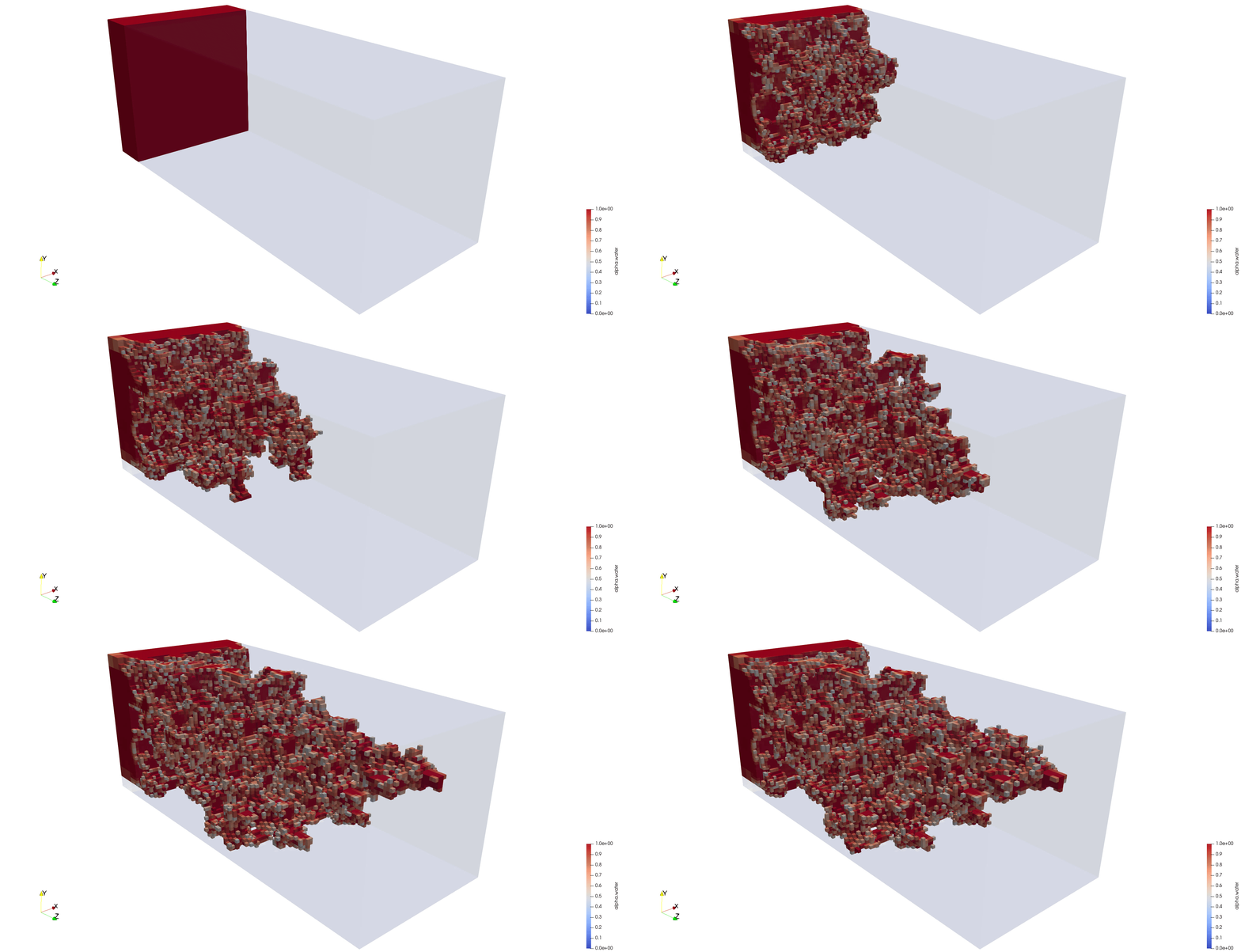
Hydrogen is a clean, efficient, and potential energy source with net-zero carbon emissions. While hydrogen storage is one of the technical issues that restrict the development of hydrogen storage. Comparing to other hydrogen storage approaches, geological hydrogen storage in saline aquifer enjoys a lot of advantages, such as a large storage capacity and great tightness. The injection and production efficiency and storage capacity of geological hydrogen in saline aquifer is closely related to the movement of hydrogen in porous media and the interaction between hydrogen, underground water, and rock. In this project, microfluidics experiments and numerical analysis of drainage and imbibition process will be performed at the micro-scale to understand the movement of hydrogen in the porous media, the injection and production mechanism of hydrogen, and the influence of the injection rate and the microstructure of rock on the injection and production efficiency. This project will shed light on the theory and design of geological hydrogen storage and the development of deep underground space.
Fabric-enriched damage mechanics
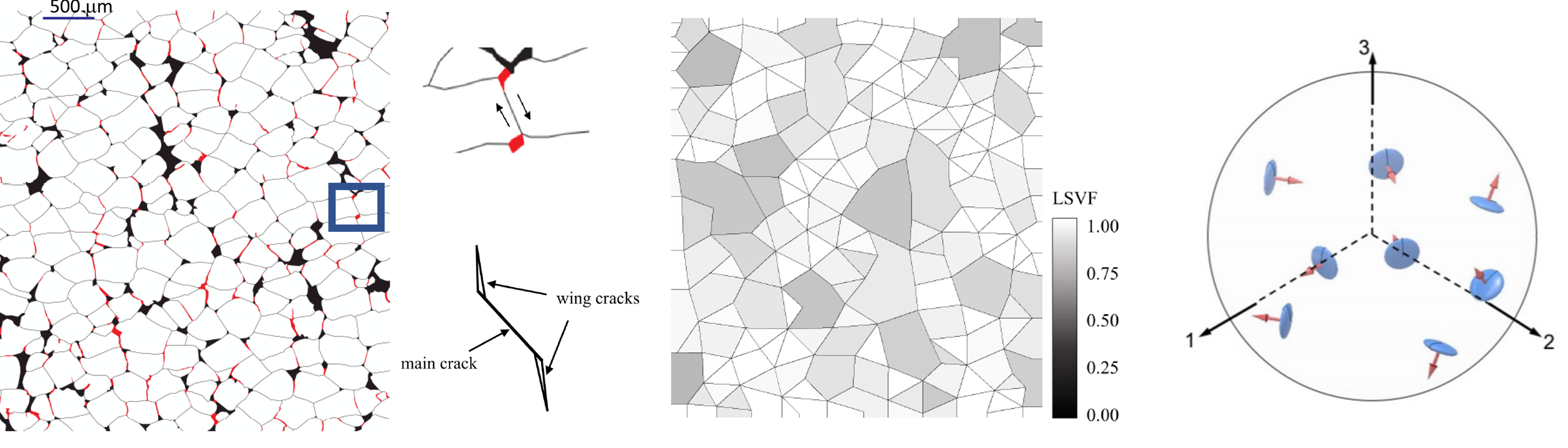
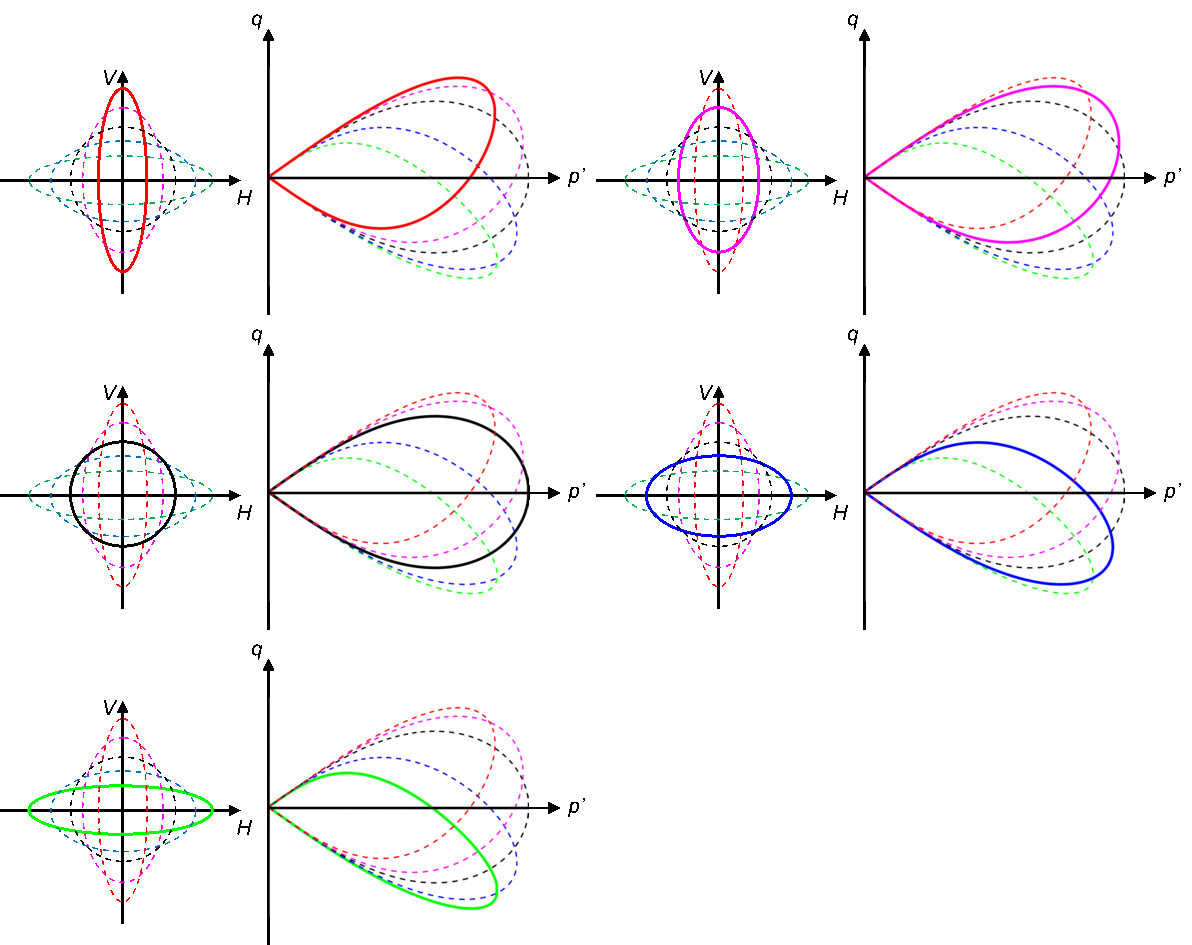
General rules that would allow one to connect continuum behavior to the micro-scale features (e.g., the geometry of cracks, pores, and grains) are of great significance in geomechanics. Our goal is to propose a fabric-enriched damage mechanics framework to understand the damage accumulation in geomaterials. Uniaxial consolidation tests and cyclic compression tests were conducted on reagent-grade granular salt in dry conditions at 150 C. 2D-microscopic images, parallel to the axis of loading, were obtained at several stages of tests. Microstructure image analyses were performed to obtain probability density functions (PDFs) of the area, solidity, coordination number, orientation, elongation and roundness of the grains, as well as the PDFs of the branch lengths, branch orientations and solid volume fraction, defined locally over polygons with edges matching grain centroids. The Discrete Wing Crack Elastoplastic Damage (DWCPD) Model was proposed based on the microscopic observations to characterize the initiation and propagation of microcracks in the polycrystalline materials. Fabric tensors are going to be calculated to assess microstructure anisotropy and its effects on the stiffness tensors.
Breakage process in granular materials
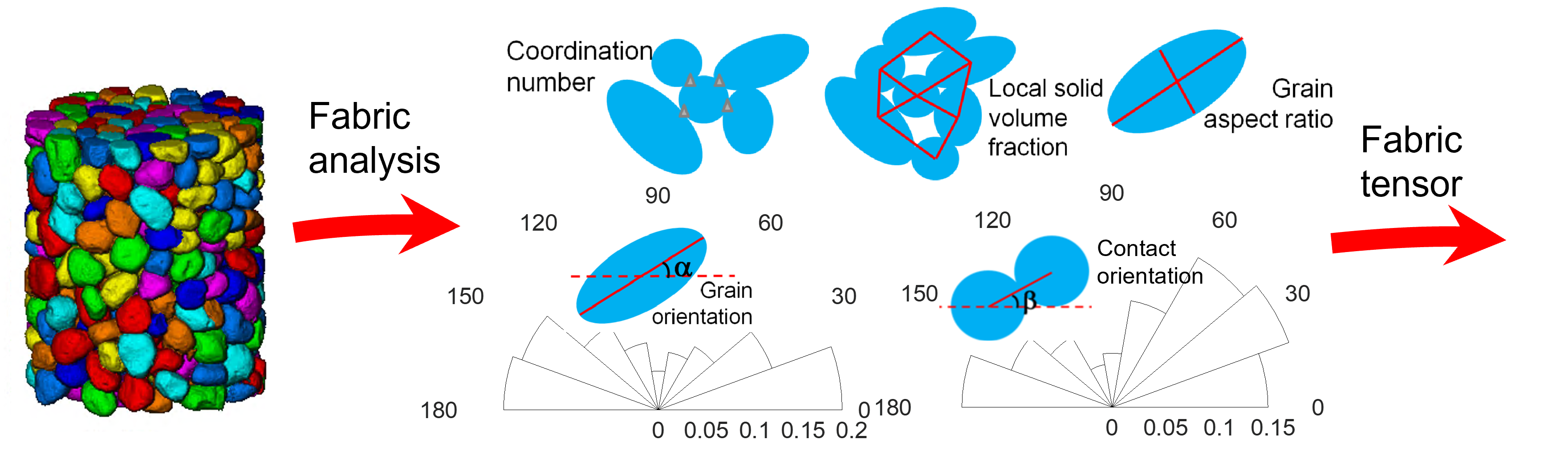
Our research focuses on the effect of microscopic grain-scale processes on the deformation of anisotropic geological solids, as well as their interaction with pore fluids. Our goal is to expand the current understanding of how the granular systems behave under extreme pressure conditions. A fabric tensor was introduced in the expression of Helmholtz free energy to characterize the anisotropic elasticity and anisotropic yielding of granular media within the framework of breakage mechanics. The effects of relative humidity on the breakage and damage processes of cemented granular materials. A continuum breakage-damage model for high-porosity granular rocks has been formulated by incorporating moisture effects on the strength of the grains, as well as on the brittle cement bonds bridging them.
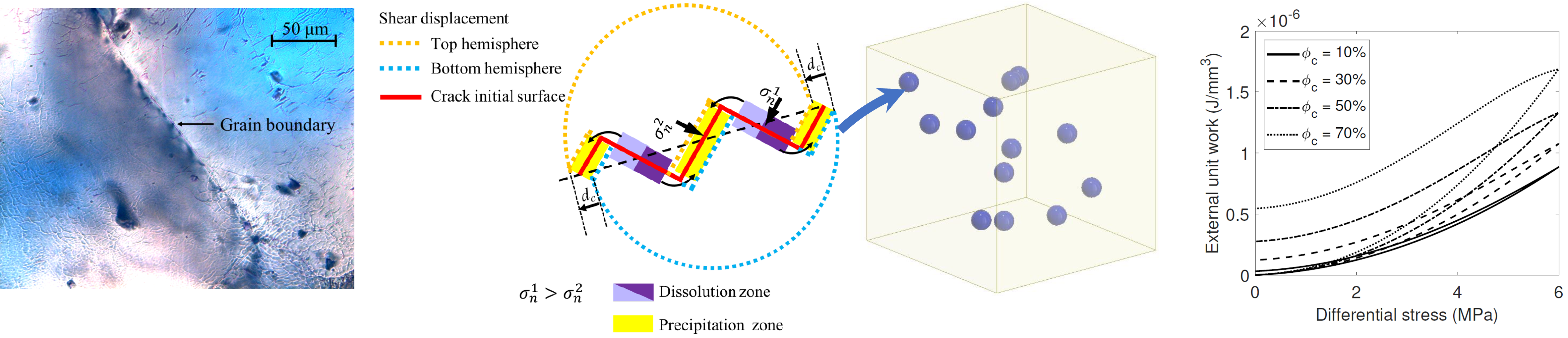
Homogenization scheme for pressure-solution driven healing
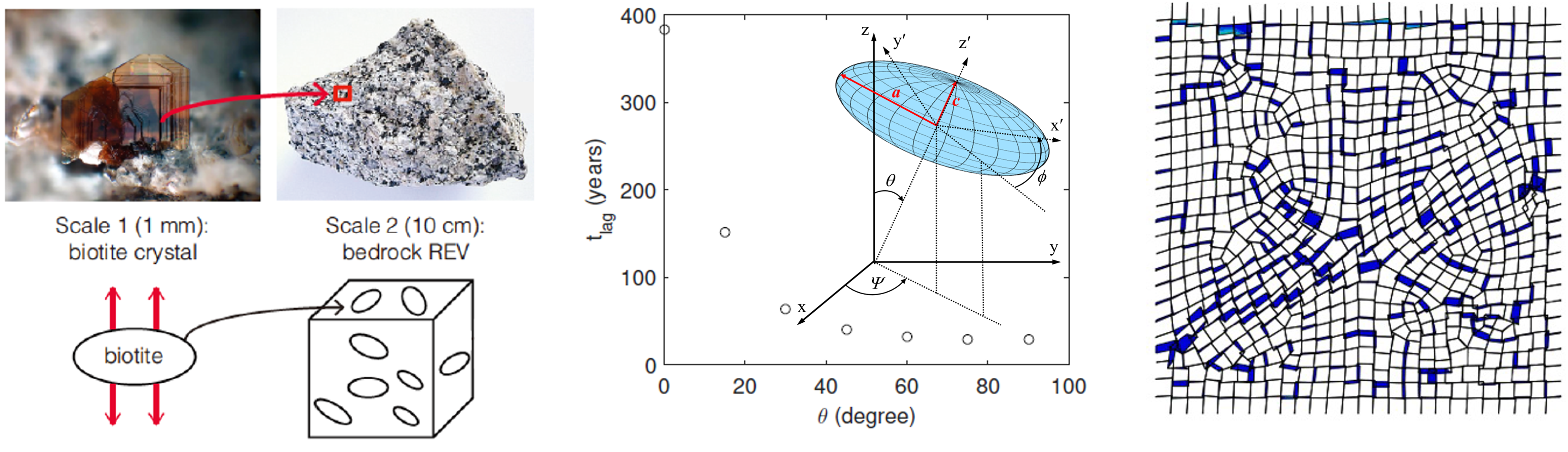
Bedrock weakening is of wide interest because it influences landscape evolution, chemical weathering, and subsurface hydrology. A longstanding hypothesis states that bedrock weakening is driven by chemical weathering of minerals like biotite, which expand as they weather and create stresses sufficient to fracture rock. Here we build on recent advances in rock damage mechanics to develop a model for the influence of multi-mineral chemical weathering on bedrock damage, which is defined as the reduction in bedrock stiffness. We use biotite chemical weathering as an example application of this model to explore how the abundance, aspect ratio, and orientation affect the time-dependent evolution of bedrock damage during biotite chemical weathering.
Multi-scale analysis on granite bedrock weathering
Bedrock weakening is of wide interest because it influences landscape evolution, chemical weathering, and subsurface hydrology. A longstanding hypothesis states that bedrock weakening is driven by chemical weathering of minerals like biotite, which expand as they weather and create stresses sufficient to fracture rock. Here we build on recent advances in rock damage mechanics to develop a model for the influence of multi-mineral chemical weathering on bedrock damage, which is defined as the reduction in bedrock stiffness. We use biotite chemical weathering as an example application of this model to explore how the abundance, aspect ratio, and orientation affect the time-dependent evolution of bedrock damage during biotite chemical weathering.